The Mer de Glace is the largest glacier in France and the most visited glacier in the world, a formidable witness to climate change. For over 50 years, the Mer de Glace has been at the centre of studies into global warming.
The melting of the Mer de Glace over the last 40 years is mainly the result of hot summers with frequent heatwaves, the result of global warming of anthropogenic origin (amplification of the natural greenhouse effect). In some years there have also been droughts with a significant shortfall in snowfall, as recently in 2022 and 2023. The strong summer melting of snow and ice quickly removes the white mantle and releases a darker rock that absorbs solar energy. The energy balance is reversed, the rock heats up, the ice cement in the mountains (permafrost) melts and there are frequent rockfalls and collapses (250 in 2023, 350 in 2022 in Mont Blanc).
An uncertain future
Its very rapid decline shows an alarming trend in the effects of rising temperatures in the Alps (+2.5°C) and worldwide (+1.5°C) since 1850.
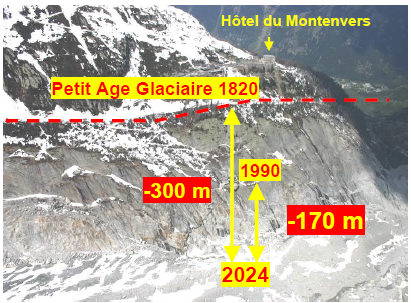
Since the end of the 19th century, the glacier has lost almost 2.5km in length and is thinning at an accelerating rate. At Montenvers, it has lost 170m in thickness since 1990.
The Mer de Glace is a reminder of the extent to which glaciers are precious indicators of the health of our planet. If efforts to reduce greenhouse gas emissions and limit global warming are not stepped up, this natural jewel could disappear in the decades to come.
By visiting this exceptional site, everyone has the opportunity to reflect on their role in protecting our environment. The Mer de Glace is not just a spectacle to be admired, but a call to action for present and future generations.
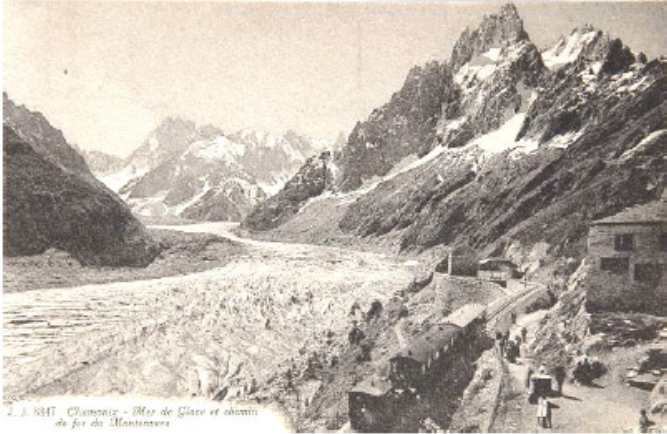
The Mer de Glace around 1915. The glacier was almost 250m thick beneath the Montenvers station. (coll. L. Moreau)
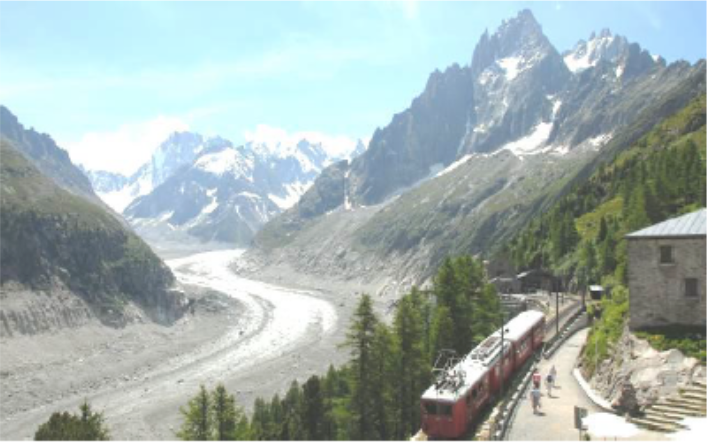
In 2023, the ice will be only 30 m thick at cave level. (cl. L. Moreau)
The Mer de Glace basin seen from the summit of the Aiguille du Moine(Ph J.F Hagenmuller)
Données IGE, institut des Géoseciences de l’Environnement (CNRS/UGA)